
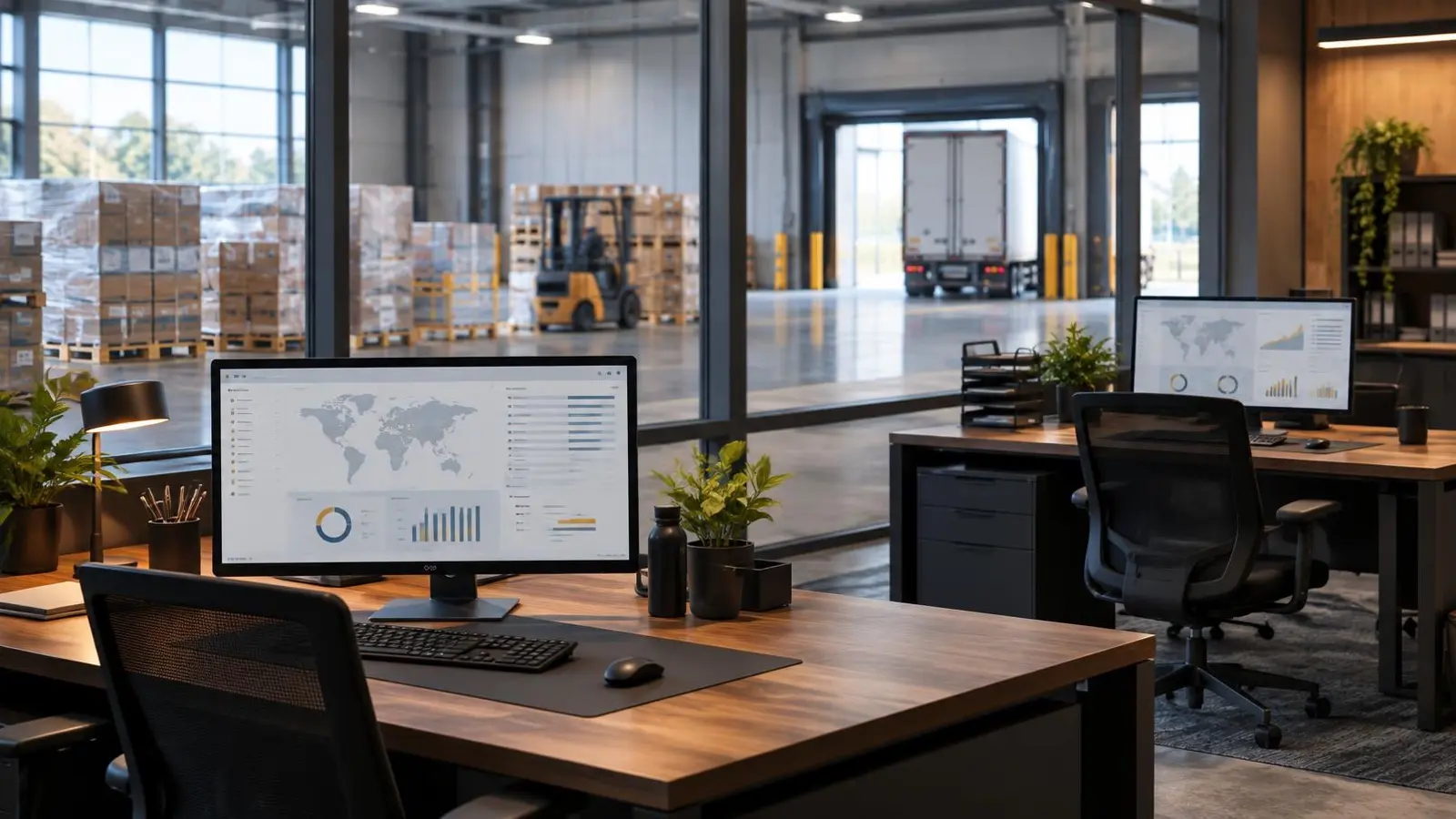
IT Support for Logistics & Freight Forwarders
A shipment moves because a message got through, a label printed and a system answered. We keep the network, workstations and connectivity behind your freight operation running when the clock is against you.
Downtime here is measured in containers
Freight forwarding and logistics run on a chain of confirmations: a booking, a customs release, a pickup, a handoff, a proof of delivery. Almost every link in that chain depends on someone reaching a system or sending a document. When a workstation will not open the transportation management platform, the confirmation does not happen, and the shipment waits at a cost that shows up weeks later.
The workload is also unusually spread out. Dispatch sits in the office, warehouse staff scan on the floor, drivers and salespeople work from phones and laptops, and overseas agents expect answers outside Miami business hours. That mix puts pressure on things that most offices never think about: how far the Wi-Fi actually reaches, whether remote access is secure enough to expose, and whether a laptop that has been in a truck for a month is still patched.
We build and maintain that foundation. Reliable wired and wireless networks, workstations that are supported rather than repaired after the fact, secure remote access, and continuity planning so a single ISP outage does not become a stopped dock.
The most common complaint is not a dead server. It is a warehouse where the signal works at the dock door and dies three racks in, so scanners queue up work that has to be redone. Or a dispatch desk that slows to a crawl when the TMS is open on six screens at once, because the office is still on consumer-grade networking.
The second is connectivity itself. Freight offices often sit in industrial parks where the only options are a business cable line and hope. One line, one outage, and the whole operation is on the phone with the carrier while trucks wait. A second path and a router that actually fails over changes that morning completely.
The third is remote access. People need to check rates, print documents and update a shipment from home or from the road, and the quick fix is usually a shared login on an open remote desktop. That works until someone leaves, or until the exposed port gets found. Doing it properly, individual accounts, MFA, a VPN or a managed remote gateway, takes an afternoon and removes a standing risk.
What a maintained logistics environment gives you
Networks sized for the floor
Wired and wireless coverage designed around racking, dock doors and handhelds, not around a router in the front office.
Workstations that do not become the bottleneck
Monitored and maintained machines for dispatch, customer service and accounting, so the TMS has a stable place to run.
A second path for the internet
Failover planning and configuration so one carrier outage does not stop booking, dispatch or label printing.
Remote access you can defend
Individual accounts, multi-factor authentication and a managed gateway instead of shared logins on an exposed desktop.
A continuity plan for the dock
A short written plan for outages and storms: who works where, what runs on a hotspot, and what has to wait.
What our logistics IT support covers
Logistics businesses we work with
Freight forwarders and customs brokers
Teams coordinating bookings, documentation and releases across time zones, where email and system access are the workflow.
Trucking and drayage companies
Dispatch offices and yards that need reliable connectivity, working printers and drivers who can reach information remotely.
Third-party logistics and distribution operations
Warehouse-plus-office businesses where scanning, labeling and shipping share one network and one support relationship.
Situations we hear about most
Why logistics companies choose us
We know the difference between office and floor
Warehouse technology fails differently from office technology. We design for racking, cold zones, dust and devices that move.
One team for both sides
The same local team handles the dispatch office and the warehouse network, so nobody has to referee between two vendors.
Local, bilingual and on site
Miami-Dade based, reachable in English or Spanish, and able to walk the floor when a remote fix is not enough.
Local support across Miami-Dade
We support freight forwarders, trucking companies and 3PL operations throughout Miami-Dade County, Doral, Medley, Hialeah, Miami Lakes, Miami Springs, the airport and seaport corridors, and Kendall, including multi-site operations.
View all service areasLogistics IT questions
No. Your TMS, WMS and freight software come from their own vendors and we do not develop or replace them. We maintain the environment they depend on, workstations, network, connectivity, accounts and permissions, and coordinate directly with the vendor when the fault is inside the application.
Let’s look at the network behind your freight
Tell us how many users, warehouse devices and locations you support, which systems dispatch depends on and what stops working first. We will come back with a plan and a clear monthly price.